


Photovoltaic energy has become a pillar of Spain’s electricity system. Hybridizing photovoltaic plants with Battery Energy Storage Systems (BESS) is an increasingly important strategy in Spain to manage solar generation and improve operational flexibility to maximize renewable energy.
How Battery Energy Storage Systems (BESS) Are Maximizing the Value of Photovoltaic Plants in Spain
In 2025, Spain installed 10,105 MW of new photovoltaic capacity. 8,966 MW were ground-mounted plants, while 1,139 MW were for self-consumption. As a result, Spain has become the second-largest photovoltaic market in the European Union.
However, the success of photovoltaics brings a new challenge. Solar production peaks in the middle of the day, especially as more installations generate electricity simultaneously. This strong correlation decreases wholesale prices during solar hours, thus reducing the economic value of photovoltaic generation.
Recent data highlights this trend. According to the Spanish Photovoltaic Union (UNEF), the capture price for photovoltaics fell from €42.28/MWh in 2024 to €36.39/MWh in 2025, and further to €29.68/MWh in the first half of 2026. In 2025, prices fell to or below zero for 797 hours amid significant photovoltaic generation. By July 7, 2026, that same number of hours had already been reached.
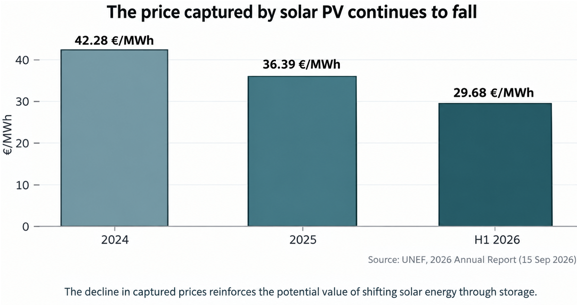
The sector’s challenge is changing. It is no longer simply about producing more renewable energy, but also about better managing when that energy reaches the system and how much value it generates.
How Battery Energy Storage Systems Help Solar Plants
In this context, solar battery storage is becoming increasingly important. Integrating Battery Energy Storage Systems (BESS) into photovoltaic plants lets operators store some of the electricity generated during peak solar hours and deliver it later when market conditions may be more favorable.
A battery lets you partially decouple generation time from delivery time. Instead of injecting all solar production during the middle of the day, you can store some of it for later delivery, when renewable production is lower, demand is higher, or market conditions are more favorable.
This ability to manage the energy produced over time can offer a photovoltaic plant several advantages, including:
- Improve the average capture price of a photovoltaic plant
- Reduce exposure to periods of zero or negative prices
- Use energy that, under certain circumstances, might otherwise be curtailed
- Optimize the use of existing grid connection infrastructure
- Provide flexibility to the electricity system
- Enable participation in certain system services
BESS should not be understood solely as a mechanism for arbitrage between low-price and high-price hours. Its potential value lies in combining different revenue streams and services.
Battery Energy Storage Systems and Grid Constraints
Renewable growth is also increasing the importance of operational flexibility. As renewable energy storage becomes more important in electricity markets with high solar penetration, battery systems can help shift generation to periods when the grid needs it most.
Storage can absorb energy during periods of high production and shift its delivery to other periods. However, batteries can’t address all constraints or curtailment. Their contribution depends on factors such as the asset’s location, access and connection conditions, storage capacity, duration, and the nature of each constraint.
This distinction is important. The economic case for adding BESS to a photovoltaic plant should not rest solely on “avoiding curtailment”, but on a joint assessment of capture prices, constraints, balancing services, voltage control, battery degradation, and operating strategy.
A More Favorable Regulatory Framework for Hybridization
Spanish regulation is also evolving to facilitate integrating energy storage systems with renewable energy installations.
Royal Decree 997/2025 of 5 November introduced specific measures designed to promote storage hybridized with renewable energy installations. These include changes to the definition of installed capacity and administrative simplification measures for certain projects. The norm exempts certain hybridized storage projects from simplified environmental assessment and, in some cases, halves processing timeframes for hybridized storage located on sites that have already undergone environmental assessment.
The norm is also part of a broader plan. The update to Spain’s 2023–2030 National Integrated Energy and Climate Plan (PNIEC) envisages reaching 22.5 GW of storage capacity by 2030, including daily, weekly, and seasonal storage.
At the same time, the new Operating Procedure 7.4 expands the options for installations to participate in voltage control. UNEF identifies this regulatory development, together with hybridization, as a new avenue for generating value for photovoltaic plants and storage systems.
Maximizing Production to Maximizing Value
Assessing the business case for photovoltaic battery storage requires analyzing BESS sizing, storage duration, expected cycling, degradation, efficiency, charging and discharging strategies, future electricity prices, and opportunities to participate in different markets.
Historically, the main variable was maximizing annual production. In a system with high solar penetration, producing an additional MWh is no longer necessarily the sole objective. The time, place, and conditions under which that MWh is delivered to the system are becoming increasingly important.
Batteries provide this flexibility, but they do not automatically make every project profitable. Their value depends on the project’s characteristics and whether the expected benefits justify the investment.
That is why the question facing many photovoltaic asset owners is changing. It is no longer just about how much a plant can produce, but about maximizing the value of its output.
The Next Phase of Solar Energy in Spain
Spain will continue to need new renewable capacity to advance its electrification and decarbonization goals. However, growth in the photovoltaic sector is entering a new phase in which generation, storage, flexible demand, and grids will need to evolve in a coordinated manner.
UNEF itself identifies electrification and storage as two of the main levers for this second stage of the energy transition.
In this scenario, battery hybridization is no longer merely a technological complement. It becomes a tool for transforming abundant renewable generation, concentrated in certain hours, into more flexible electricity that is potentially more valuable to the market and the system.
The next leap for Spanish photovoltaics may not consist solely of installing more panels. Above all, it may mean learning to manage more effectively the energy those panels can already produce.
Unlocking More Value from Solar Energy
Hybridization with Battery Energy Storage Systems (BESS) marks a new stage for Spanish photovoltaics. As solar generation grows, energy storage can provide flexibility, shift electricity to higher-value periods, and create new opportunities for market participation and system services. However, profitability depends on each project’s characteristics, size, and operating strategy. The sector’s challenge is therefore evolving from maximizing generation alone to maximizing the value of the energy produced. Ultimately, the future of photovoltaics lies not only in producing more, but in producing better.
How NUS can help
NUS helps organizations evaluate the feasibility of integrating BESS with existing or planned photovoltaic assets through independent analysis of storage sizing, project economics, market participation opportunities, and long-term energy strategies. By evaluating each project’s unique characteristics, NUS helps clients identify practical solutions that enhance flexibility and maximize the value of renewable energy investments.
For more information, please contact us at https://www.nusconsulting.com/es/.