


The energy transition Spain has undergone over the past decade has put balancing services in the electricity system at the center of technical and regulatory debate.
These services (managed by the system operator, Red Eléctrica de España – REE), are the mechanism that always maintains the balance between generation and demand, ensuring that the quality, security, and continuity of supply are not compromised.
These balancing services had accounted for a moderate share of total costs in the system historically. However, due to the profound structural changes in the energy mix and the increased volatility associated with renewable generation, their relevance and financial impact have risen substantially in the recent past.
In this article, we describe their evolution over the last years, and especially during the twelve most recent months.
Origin and key role of balancing services
Electric power systems operate under a basic rule: the energy generated must constantly match the energy demanded. Any deviation could result in frequency instability, system failures, or even widespread blackouts. To prevent this, REE has a set of tools known as balancing services (or operational services), which include resolving technical restrictions, secondary and tertiary control, management of deviations, the replacement of reserves or supplementary services such as voltage control.
In the past, the electricity system was mainly based on large thermal and nuclear power plants. This allowed increased predictability and inertia of the grid, which made balancing tasks easier. Operations were relatively stable, and the need for balancing services was much lower.
Transformation of the energy mix and increased complexity
The surge in unmanageable renewable generation, particularly wind and solar power, has radically transformed the management of balancing services.
Spain is one of the European countries with the highest penetration of these technologies, which brings environmental and economic benefits. However, it also increases the technical complexity of the system, since renewable generation that depends on wind and sun creates inherent unpredictability that requires greater capacity to correct deviations, adjust system operation, and ensure the availability of reserves.
This increase in unpredictability has multiple consequences:
- Greater need for real-time adjustments to compensate for unexpected deviations.
- Increased use of technical restrictions, especially in areas with high renewable production but limited transmission capacity.
- Demand for faster and more flexible balancing services, where technologies such as storage are starting to play a key role.
- Direct impact on costs, as the costs of these services are passed on to the electricity price.
As a result, balancing services have become an essential element to guarantee stability in a system that is increasingly decarbonized, but also more challenging from an operational standpoint.
Analysis of the main cost components of balancing services
Balancing services can be broken down into several categories, each of which has different dynamics and costs:
- Technical restrictions: Restrictions on transmission and distribution networks sometimes make it necessary to reduce demand in congested regions and activate alternative generation in other areas. These restrictions account for the majority of the cost of balancing services.
- SRAD: Active demand response services (Servicios de Respueta Activa de la Demanda – SRAD in Spanish) allow for some degree of adjustment to the demand of certain business consumers to maintain grid stability, in exchange for a fee based on the companies’ availability to reduce their demand at the system operator’s request.
- Deviation Management: Deviations between energy scheduled and actual demand result in settlements and additional costs.
- Supplementary Services: Voltage control processes and the replacement of reserves or regulation bands generate costs, which are included in system balancing costs.
Trends in system balancing costs and blackout in April 2025
The following charts show the evolution of the system balancing costs over the past few years, and in greater detail over the past 12 months (through March 2026).
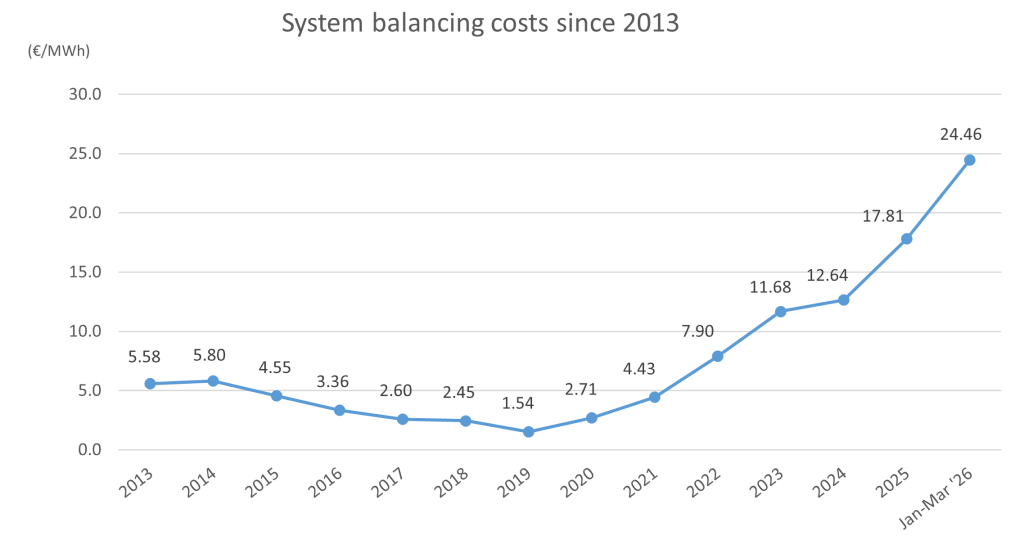
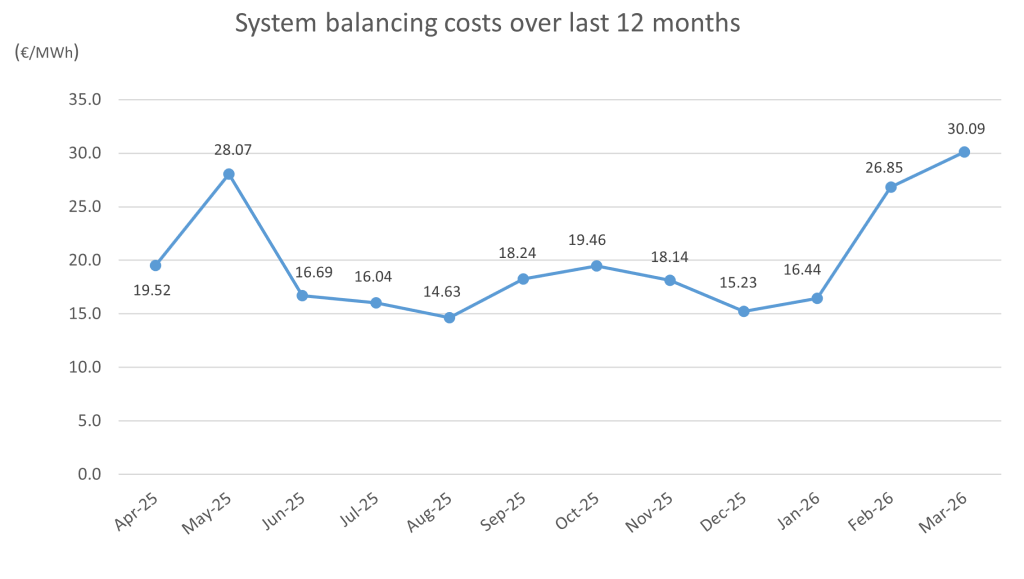
These figures clearly show the structural shift that has taken place and the general increase in these costs over the past few years. The monthly analysis reveals particularly notable increases during months of peak operational demand.
The blackout that took place on April 28, 2025, which hit the entire Iberian Peninsula, also revealed the system’s vulnerability to certain extreme conditions, and marked a turning point in the perception of operational risk. Over the following months, REE implemented a strategy called Reinforced Operation, which involved more intensive use of synchronous technologies to manage the system’s technical restrictions. This resulted in an additional cost of approximately 1,000 million euros on the electricity bill.
Challenges and transition to a more flexible system
Several factors are currently aggravating the difficulty of managing the system’s balancing services, including the following:
- Increasing weather uncertainty.
- Greater reliance on renewable energy without associated storage.
- Increased number of congestion events and renewable curtailment due to limited transmission infrastructure in some parts of the country.
The future of the costs of balancing services will be determined by the power system’s ability to adapt to a context of greater electrification, more renewable generation, and new forms of consumption.
The solution does not simply lie in increasing the use of balancing services, but in upgrading and improving transmission and distribution networks, expanding storage capacity, and increasing the flexibility of grid management and its ability to manage demand.
Conclusion
The energy transition has significantly increased the use of balancing services in Spain’s electricity system and their impact on electricity costs, while the growing penetration of renewable energy has increased operational complexity.
In this context, improving transmission and distribution networks, as well as developing a more flexible system supported by storage and more efficient management of generation and demand, will be key to ensuring the security and stability of supply.
For more information on the evolution of balancing services and their impact on energy prices in Spain, please feel free to contact us at https://www.nusconsulting.com/es/.