


The Statute for Energy-Intensive Consumers is the regulatory framework established to benefit industries with high electricity consumption in Spain. Its purpose is to provide a legal and financial framework that reduces these industries’ electricity costs, thereby enhancing their competitiveness in international markets and mitigating the impact of energy prices on their production costs.
The Statute regulates both the requirements for qualifying as an “energy-intensive consumer” and the associated benefits — primarily subsidies and compensations — as well as the obligations these companies must accept in return.
Approval and initial framework
Although the European Commission had already established the legal framework in 2014 at european level, it was not until December 15, 2020, when the Statute of Energy-Intensive Consumers was published in Spain. For the first time, Its entry into force led to the creation of a system providing access to subsidies, technical obligations, and control mechanisms for energy-intensive consumers in Spain.
The initial goal was twofold: on the one hand, to reduce certain regulated costs on electricity bills; and on the other, to promote greater price predictability through medium- and long-term contracts tied to renewable energy.
Regulatory changes between 2022 and 2026
Between 2022 and 2023, the statute underwent major changes to bring it into line with the new 2022 European Guidelines, which replaced the previous guidelines on state aids for energy and climate, dating from 2014.
From 2024 to 2026, further revisions to the Statute were made, resulting in a loss of predictability in the legal framework for businesses.
The most significant changes since the Statute came into force have been as follows:
- Redefinition of eligible sectors, based on the risk of relocation, distinguishing between “at-risk” sectors and “high-risk” sectors.
- Revision of the eligibility thresholds for the ratio of consumption to Added Gross Value (AGV), which have been modified on several occasions over the years.
- Expansion of the potential number of eligible companies.
- Implementation of new ways of providing benefits, such as discounts on a portion of transmission and distribution charges, which have been applied intermittently.
- Revision of annual certification methods, with greater administrative automation, while maintaining monitoring requirements.
Current eligibility requirements
Companies must currently meet the following requirements, among others, to obtain and maintain the status of an energy-intensive consumer:
- Operate in a sector or subsector that falls under one of the Spanish CNAE (National Classification of Economic Activities in Spanish) codes listed in the legislation.
- Have used more than 1 GWh of electricity annually for at least two of the previous three years.
- Have had a ratio between annual consumption and added gross value at the corresponding supply point exceeding 0.61 kWh/€ for at least two of the previous three years.
- Comply with certain obligations regarding energy management, consumption forecasting, and forward energy contracts.
- Have used at least 46% of energy during off-peak hours for at least two of the previous three years. However, this requirement has been exceptionally waived for the year 2026.
Benefits and cost savings
Over the years, being registered as an energy-intensive consumer has provided access to several cost reduction mechanisms:
1. Compensation for electricity system charges
Financial aid provided in the form of a direct subsidy to cover a portion of the cost of electricity system charges paid by the consumer during the previous year.
The aid available to each consumer depends on the annual budget allocation for this purpose, as well as the sector of activity, which determines the classification of the energy-intensive consumer as either a “at risk” or “at significant risk”.
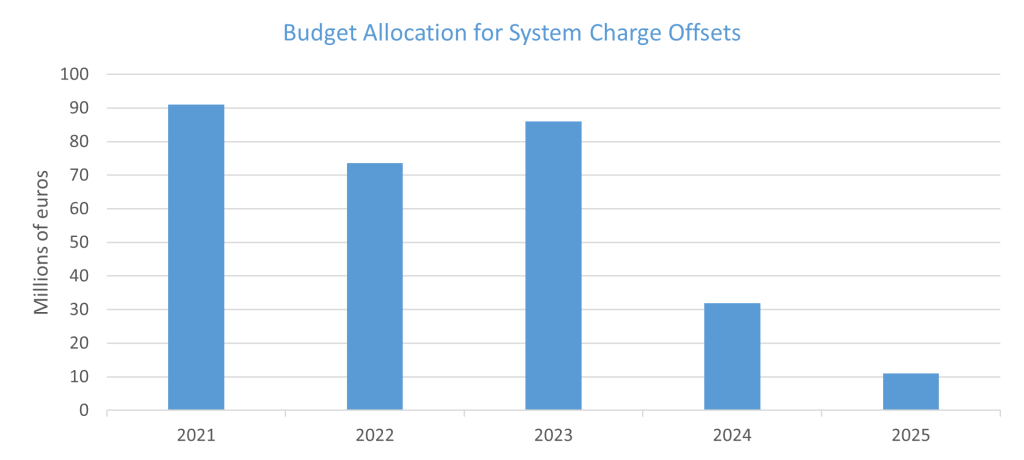
Over the past two years, the budget allocation for this subsidy has been significantly reduced, as shown in the following chart.
2. Risk coverage for medium- and long-term supply contracts
Access to credit insurance and guarantees or collateral provided by a state fund created to support energy-intensive consumers in purchasing renewable energy through long-term Power Purchase Agreements (PPAs).
3. Reduction of transmission and distribution charges
An 80% discount on all components of the electricity billing related to transmission and distribution charges, including both fixed components based on contracted power and variable components based on energy consumption.
This discount is applied directly to the electricity bill. Although it has been applied intermittently in recent years, it is currently in effect least through the end of 2026.
Conclusion
Since its adoption, the Statute for Energy-Intensive Consumers has served as the instrument enabling the provision of specific aid to sectors highly exposed to electricity costs.
Over the years it has been in effect, actual cost savings have varied significantly depending on consumption profiles, plant size, budget allocations, and the capacity to efficiently meet the corresponding requirements.
Following multiple changes since its entry into force, in 2026 the balance between the benefits received by energy-intensive consumers and the commitments they must fulfill to retain their certification is very different from what it was a few years ago. Currently, the benefits are more selective and depend to a greater extent on both each company’s profile and legislative and budgetary support at the political level.
In this context, the decision to apply for or remain in the energy-intensive consumer regime requires an individualized economic analysis, considering both the potential cost savings and the related compliance costs.
For more information on all the details of the Energy-Intensive Consumer Statute and its impact on electricity costs across different industrial sectors, please feel free to contact us at https://www.nusconsulting.com/es/.