

The United States Strategic Petroleum Reserve (SPR) is made up of four sites along the coast of Texas and Louisiana. The SPR comprises 60 salt caverns. Each cavern is cylindrical in shape with an average diameter of about 200 feet and a height of 2,550 feet. It was established in 1975 by President Gerald Ford in reaction to the 1973-74 Arab Oil Embargo under the Energy Policy and Conservation Act of 1975 (EPC).
The SPR is authorized to hold approximately 714 million barrels of crude oil. At its peak in late 2010, the SPR held in excess of 726 million barrels.
The stated maximum withdrawal rate from the SPR is 4.4 million barrels per day (mb/d). However, last December the Department of Energy (DOE) stated that under the current circumstances (i.e., crude levels and facility infrastructure), the current withdrawal rate has been reduced to 2.7 mb/d.
Analysts and the DOE generally consider 250 million barrels as the minimum threshold level needed to maintain groundwater displacement pressure to maintain physical cavern integrity.
At present, the SPR holds 319 million barrels. Between the Biden and Trump administrations, the reserve has declined by 352 million barrels, as each president has attempted to use the SPR to keep crude and gasoline prices low for consumers and political reasons.
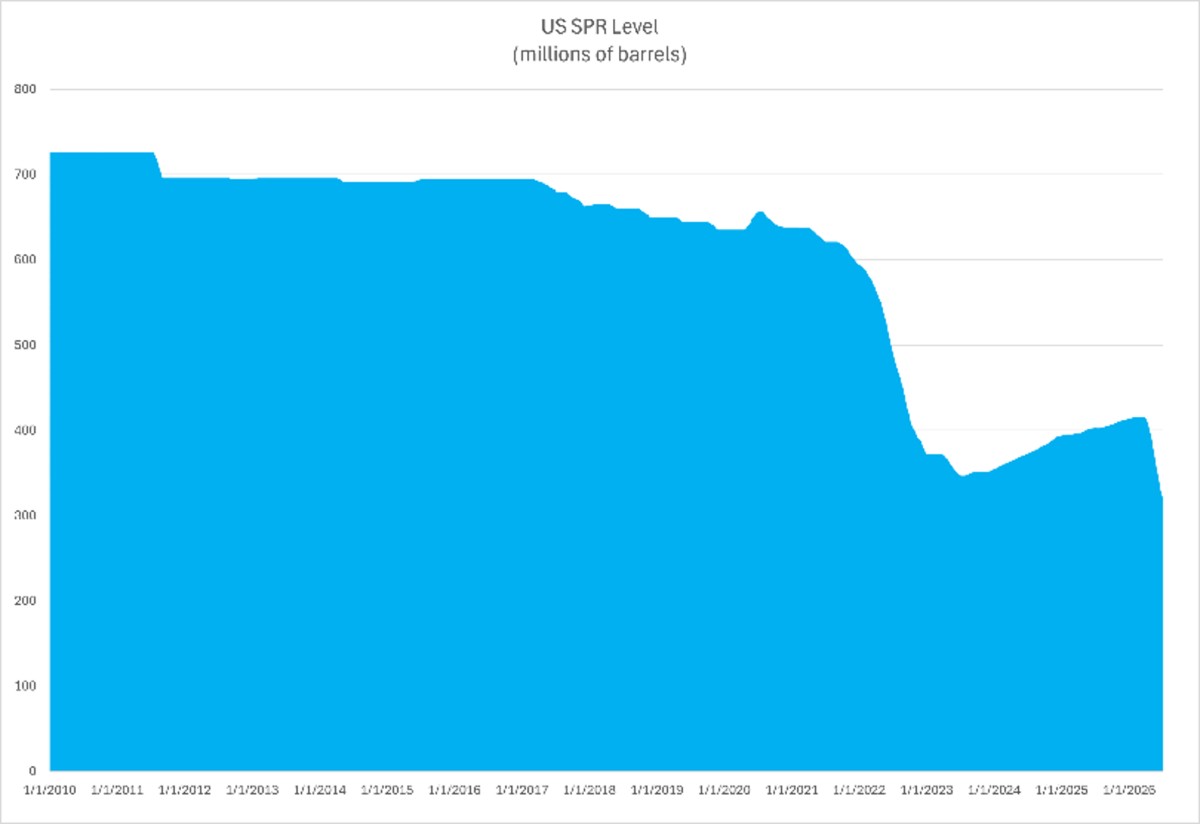
Since the start of the US conflict with Iran, the Trump administration has withdrawn approximately 100 million barrels from the SPR. In March, President Trump authorized a total withdrawal from the SPR of 172 million barrels. The result has been that both crude oil and gasoline prices, while increasing due to the closure of the Strait of Hormuz, have not increased to the level most market analysts predicted.
At its current depleted level (i.e., the lowest in the last 40 years), the Trump administration may not be in a position to rely on the SPR to dampen prices for too much longer. Over the last 15 weeks, withdrawals from the SPR have averaged 6.4 million barrels per week.
At this rate, the SPR will hit the 250 million barrels level in approximately 11 weeks.
This critical situation was most likely weighed heavily on President Trump’s when he signed the Memorandum of Understanding (MOU) with Iran. The document, which we have commented on in prior analysis, in effect gave Iran much of its wish list in return for the opening of the Strait.
While commenting on the MOU, President Trump stated that “I didn’t want to see economic catastrophe” and added that he did not want to be compared with Herbert Hoover – the president who presided over the Great Depression and the collapse of the stock market.
The recent resumption of strikes by the US on Iran, along with Iran’s targeting of several vessels in the Strait, clearly terminates the MOU. President Trump has ratcheted up the military strikes on Iran in an attempt to pressure it to reopen the Strait; while Iran will be looking to withstand US attack once again, retaliate against US bases and its neighbors, and continue to control the flow of traffic through the Strait.
Assessing the situation purely through the lens of the energy markets, time is on Iran’s side. As previously stated, the US SPR (and other reserves around the world) are being stretched and do not have unlimited capacity. The tighter the global supply of crude and derivative products is, the more economic (and political) pressure will build on President Trump and his allies.